 English
Scheduled arrival does not mean departure time
After landing, there may still be disembarkation, passport control and luggage collection before you reach your chauffeur.
A transfer of approximately 15–18 km where the aim is not simply to reach the Port of Barcelona, but the terminal where your ship departs. In favourable conditions, the road journey to Moll Adossat takes around 20 minutes; for a cruise, however, the crucial factor is allowing enough time between your flight's actual arrival and the cut-off time specified by the cruise line.
The Port of Barcelona has several passenger terminals. Most cruise activity is concentrated at Moll Adossat, where different ships use different terminals. In 2026, a reorganisation process began that will eventually lead to greater concentration of cruise activity at this quay.
Two passengers may land on the same flight and board different cruises that day. Although both may specify “Port of Barcelona”, their vehicles may need to finish at different points within the port area.
When booking, it is more useful to provide the cruise line, ship name and terminal shown in your boarding documentation than simply entering “port”.
The Port of Barcelona is progressively concentrating international cruise activity at Moll Adossat. It is therefore advisable to check the terminal assigned for your specific travel date rather than relying on an old guide, a map saved months earlier or the terminal used by the same ship on another call.
Barcelona-El Prat operates across T1 and T2. On this route, identifying the correct airport terminal is particularly important because an initial mistake can eat into the time you may need to check luggage and complete the cruise boarding process.
T1 and T2 are separate, and Aena operates its own shuttle between them. If the group intends to travel together to the cruise port, provide all flight details so we can assess where and when everyone should meet before leaving the airport.
With a hotel transfer, a road delay may be easier to absorb. With a cruise transfer, there is a point after which arriving late can have much greater consequences. Planning should start with the boarding time required by the cruise line and work backwards, allowing enough time for the road journey, leaving the airport and possible flight-related delays.
After landing, there may still be disembarkation, passport control and luggage collection before you reach your chauffeur.
The proximity between El Prat and the port does not eliminate the risk of congestion; it is better to allow a margin rather than plan around the best possible journey time.
The check-in or boarding cut-off time should be taken from your cruise documentation, as there is no universal rule across all cruise companies.
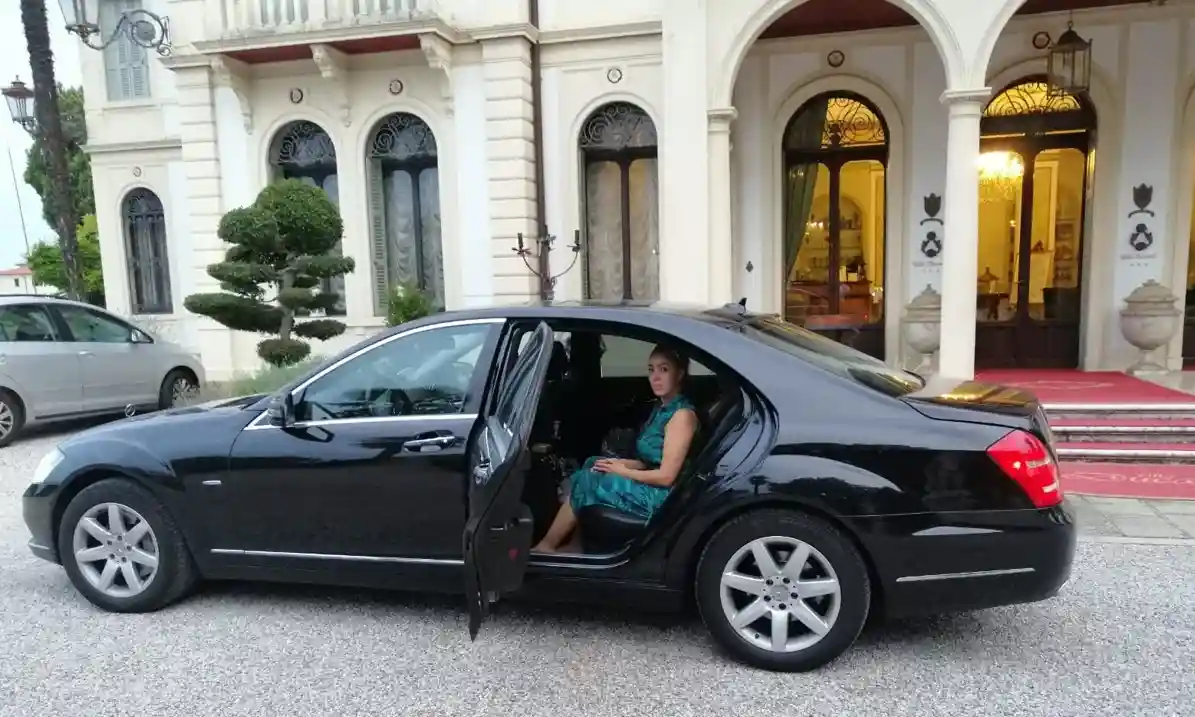
The Port of Barcelona allows vehicles to enter the cruise area to drop off or collect passengers and luggage. This means the transfer can be planned to the relevant terminal area rather than ending at Drassanes or another public transport stop outside the quay.
The chauffeur can enter the port area to drop off passengers and luggage in the permitted zone corresponding to the cruise operation.
Port regulations allow passengers to be dropped off or collected, but do not permit unrestricted prolonged parking within the cruise area.
Drassanes is a useful reference point for connecting with urban transport and the Portbus, but the Moll Adossat terminals are further inside the port area. For someone travelling with luggage and facing a boarding deadline, this difference is operationally important.
Public transport is available for getting closer to the port, but there is no single metro or train service running directly from T1/T2 to every terminal at Moll Adossat. A common option is to travel to the Drassanes area and then connect with the port's shuttle service.
| Aspect | Private transfer | Public transport |
|---|---|---|
| Start | T1 or T2 depending on your arrival | Metro, train or bus from the airport |
| Cruise terminal | Used as the service destination | May require a final connection with the Cruise Bus/Portbus |
| Changes | No change of transport required | One or more depending on the route |
| Luggage | Travels in the reserved vehicle | Must be managed throughout each connection |
| Boarding time | The transfer can be planned around your flight and terminal | Waiting and connection times need to be factored in |
The T-3 Portbus service connects the cruise terminals with the Drassanes area and other urban transport links. For a traveller with little luggage and plenty of time, it can be a perfectly valid alternative; with several suitcases, children or a tight flight-to-ship connection, the equation changes.
On this route, luggage can matter more than distance. A couple setting off on a long cruise may have more luggage than four passengers travelling for a weekend break. Vehicle category should therefore be selected based on the actual number of passengers and bags, not simply the number of available seats.
Several large suitcases may require more luggage capacity than the number of passengers alone would suggest.
It is advisable to list all bulky items before confirming the vehicle category to avoid luggage capacity becoming an issue when you land.
When a group is travelling on the same cruise and to the same terminal, a minibus or coach can make the journey easier for everyone and avoid splitting passengers between different vehicles.
A short transfer does not remove the logistical complexity of travelling as a group. If eight, fifteen or thirty passengers land together, the challenge is not covering twenty kilometres, but bringing everyone, their luggage and documentation together and getting them to the same cruise terminal within the planned time.

If the group arrives in stages over several hours, it may make more sense to arrange separate pick-ups rather than keep the first passengers waiting at the airport. If they arrive close together, a coordinated departure can make it easier for everyone to reach the ship together.
The short distance between the airport and port does not make every connection safe. You need to allow for disembarkation, any required checks, luggage collection, leaving the terminal, the road journey and the boarding process. The decisive time is not simply the ship's scheduled departure, but the cut-off time communicated by the cruise line.
If your flight is significantly delayed, a transfer can reduce waiting times and land-based connections, but it cannot eliminate airport procedures, recover time already lost or change the boarding cut-off set by the cruise company.
If both services have been booked separately, check the terms and conditions of your airline, cruise line and travel insurance carefully. Do not assume that a company will wait for you simply because your flight is scheduled to arrive on the same day.
Port → airport may look like the same route in reverse, but it has a different time constraint. The time the ship docks does not necessarily equal the time a passenger can leave the terminal with all their luggage. Your return flight should be planned taking into account disembarkation, leaving the port, the road journey and the recommended airport check-in time.
Disembarkation may take place in stages, and passengers still need to collect their luggage before reaching the area accessible to vehicles.
Barcelona-El Prat operates from T1 and T2; providing the correct airline and flight details allows the service to finish at the relevant terminal building.
Not every passenger landing in Barcelona is heading into the city. These routes serve beaches, parks, cities and travel corridors that are very different from a direct transfer to a cruise ship.
Swap the boarding gangway for a direct arrival at a hotel, villa or apartment on the Mediterranean coast.
A short connection for those landing at El Prat and staying south of Barcelona, without needing to travel into the city centre.
Continue south by road to a historic port city, without having a cruise timetable dictate your arrival.
A transfer designed to start your holiday at the resort straight after your flight, particularly useful for families travelling with luggage.
Cross the metropolitan area towards the north-east and finish at an urban destination rather than a port complex.
A longer tourist transfer where the specific hotel and Costa Brava traffic replace the cruise terminal as the key detail.
Turn the transfer into a journey towards the mountain range rather than the coast, with a completely different road itinerary.
An intercity route towards the north-east for those whose next stop is Girona rather than Barcelona.
For travellers whose flight marks the start of a coastal holiday and who need to arrive directly in the Maresme hotel area.
Continue directly from the airport terminal to holiday accommodation in a coastal town beyond Tarragona.
The one shown in your cruise line's or cruise operator's current documentation. The Port of Barcelona has several terminals and is undergoing a gradual reorganisation, so you should not assume a terminal based solely on the cruise company's name.
No. Drassanes serves as a connection point to the urban transport network and Cruise Bus, while the Moll Adossat terminals are located within the port area. For a private transfer, it is important to know the actual boarding terminal.
The Port of Barcelona allows vehicles to enter the port area to drop off and collect passengers and luggage, although the cruise areas cannot be used for prolonged parking.
There is no universal time allowance. You should work backwards from the boarding cut-off communicated by the cruise line and allow for disembarkation, any required passport checks, luggage collection, meeting your chauffeur and the journey to the terminal. The more independently your flight is booked from your cruise, the more cautious you should be.
Provide the approximate number and size of your bags. On cruise trips, luggage volume is often high compared with the number of passengers, so a minivan or larger vehicle may be required even if there are still spare passenger seats.
A cruise starts before you step on board: it starts when your flight, luggage, passengers and terminal all fit within the same schedule. Enter your arrival details and the correct port destination to arrange a vehicle that finishes where your sea journey actually begins.
I had a 5:30 AM pickup for the airport in Alicante. The driver arrived 10 minutes early, sent a polite text to let me know he was waiting outside, and handled everything with absolute professionalism.(09/23/2026) David Miller
We used Zonetransfers for airport transfers back and forth during a family trip to Madrid. On-time pickups, comfortable vehicles, and very friendly drivers. Will definitely use them again.(09/15/2026) Evelyn Campbell
Booked a private transfer from Barcelona Airport to our city-center hotel. Our driver, David, was exceptionally polite, helped with our heavy luggage, and gave us a few great local tips on the way.(09/11/2026) Rachel Henderson
What I appreciate most is knowing the exact cost upfront without unexpected luggage surcharges or meter surprises. Quick booking on the website and excellent customer support throughout.(09/06/2026) Emma Reed
We needed a transfer from Barcelona to Girona Airport early in the morning. The driver was there on time and we got to the airport with plenty of time. Very handy.(09/01/2026) Rachel Moore
Booked a transfer from Lisbon Airport to Faro. Long drive, but the car was comfortable and the driver was friendly. We arrived without any problems.(08/30/2026) Tom Harris
We used Zonetransfers for a transfer from Madrid to Ciudad Real. The driver was on time and the car was comfortable. Exactly what we needed.(08/25/2026) Claire Morgan
Booked a private transfer from Lisbon Airport to Sintra. Driver was waiting when we came out and helped with the bags. Simple and hassle-free.(08/22/2026) Jack Wilson
We needed to get from Valencia to Barcelona with quite a few bags, so we decided to book a private transfer. The driver arrived on time, helped us with the luggage and we went straight to our hotel in Barcelona. It worked really well for us.(08/14/2026) Sophie Turner
We booked a transfer from Lisbon Airport to Faro as we were staying in the Algarve for a few days. It was a long drive but the car was comfortable and the driver was friendly. We just sat back and enjoyed the trip instead of worrying about trains and changing buses.(08/07/2026) James Walker