 English
 The route leaves Barcelona towards Lleida
The opening section crosses inland Catalonia before joining the wider corridor towards the Ebro valley.
From €698. This private road transfer covers approximately 620–630 km between Barcelona-El Prat and Madrid. The usual route follows the AP-2/A-2 corridor through Catalonia and Aragon before reaching the Community of Madrid. Driving time is around six hours, although traffic, reasonable stops and the final address in Madrid can make the actual journey longer.
Barcelona Airport to Madrid is a full cross-country road journey rather than a short regional airport transfer. The route runs through the interior of Catalonia and Aragon before continuing towards the Spanish capital. ZoneTransfers gives an approximate distance of 620 km and a driving reference of around six hours via the AP-2/A-2, with Zaragoza as the main intermediate landmark.
The opening section crosses inland Catalonia before joining the wider corridor towards the Ebro valley.
Zaragoza is a major geographical reference on the long road between Barcelona and Madrid.
Once Madrid is reached, the journey continues through the metropolitan road network to the specified final address.
Traffic, roadworks, peak travel periods, requested stops and the location of the final address can all affect the total journey time.
Zaragoza is an important point on the route, but reaching it does not mean that passengers need to change vehicle. With a private Barcelona-El Prat to Madrid transfer, passengers and luggage remain together throughout the journey. A stop in Zaragoza or elsewhere can be discussed in advance according to the booking conditions.
Passengers and luggage stay together from the Barcelona airport terminal until the final destination in Madrid.
On a journey lasting several hours, a short stop may be arranged depending on the booking conditions and the requirements of the trip.
If you need to collect another passenger, make a longer stop or leave the main corridor, this should be specified in advance so the service can be assessed correctly.
A long-distance journey starts with an accurate airport pickup. Providing the terminal, flight, passenger details, luggage requirements and complete Madrid address helps define the service before the vehicle leaves El Prat.
Madrid covers numerous districts and neighbourhoods, so a request for simply “Madrid city centre” does not identify the final address precisely enough for a journey of this length. The destination could be in Centro, Salamanca, Retiro, Chamartín, Arganzuela, Chamberí, Moncloa-Aravaca or another part of the metropolitan area.
Even within Centro, individual neighbourhoods have different access arrangements and traffic conditions.
A destination in Castilla, Nueva España or at Chamartín station can require a different final approach from a hotel in the south of the city.
Reaching Atocha involves a different urban approach and may use the M-30 depending on traffic and the final address.
After arriving at the outskirts, there may still be a significant urban section before reaching the destination. Total journey time should therefore not be calculated only to the point where the A-2 reaches Madrid.
After leaving the A-2, Madrid’s metropolitan road network distributes traffic towards different parts of the city and surrounding area. The M-30 and M-40 are key reference points when determining the most appropriate approach to the final destination.
It can provide access towards central districts, Atocha, Chamartín and other major urban routes.
It can be relevant for destinations outside the central area or where crossing the inner part of Madrid is unnecessary.
The exact address makes it possible to determine the most coherent ring-road, exit and urban access before entering the city network.
Madrid operates a municipal Low Emission Zone. Access and circulation are subject to conditions based on vehicle environmental classification and certain exceptions.
This is an operational requirement rather than a promotional point. Environmental-access regulations can change, so the applicable requirements should be checked for the service date.
They mean that specific circulation conditions apply. Madrid also distinguishes different areas and environmental regimes within its mobility regulations.
High-speed rail is a major alternative on the Barcelona–Madrid corridor, particularly for individual travellers. A private road transfer serves a different travel pattern: airport pickup at T1 or T2, one vehicle for the whole journey, luggage kept with the passengers and drop-off at a specific Madrid address.
| Travel factor | Private transfer | High-speed rail |
|---|---|---|
| Starting point | T1 or T2 at Barcelona-El Prat | Requires reaching the relevant railway station first |
| Journey between cities | ≈ 6 h by road | Much shorter on direct services |
| Changes | One vehicle | Airport → station + train + possible final connection |
| Final destination | Hotel, home or business address | Madrid railway station |
| Luggage | Remains in the vehicle | Traveller manages it during connections |
| Larger groups | Can travel together in one vehicle | Requires individual seats and coordination |
| Privacy | Private vehicle throughout the journey | Shared public transport |
Examples include groups, substantial luggage, door-to-door requirements, professional equipment, special schedules, animals admitted according to the applicable conditions, or simply keeping the same private vehicle for the entire route.
A private transfer can finish at a Madrid railway station when the passenger has a subsequent train connection. Atocha and Chamartín are separate railway hubs in different parts of the city, so the exact station should form part of the booking details.
Atocha is located by the Retiro and Arganzuela areas and uses different urban access routes from Chamartín.
Chamartín station is in the Chamartín district and can be particularly relevant for rail connections towards northern Spain.
If the vehicle ends at a railway station, include the station name, train details and departure time in the booking.
The Barcelona–Madrid corridor connects major business, institutional and trade activity. For several passengers travelling with meetings, equipment or a business address away from the railway axis, the private car provides a different setup from high-speed rail: fewer connections and one private space throughout the road journey.
The vehicle can finish directly at the specified office, hotel or meeting location.
A group can remain together, talk during the journey and keep the same luggage throughout the transfer.
Audiovisual equipment, samples, exhibition materials or other bulky items can make an airport-to-train-to-city journey less convenient.
On a six-hour road journey, vehicle category affects available space, comfort and luggage capacity. Passenger numbers should therefore be considered together with luggage requirements and the length of the trip.
Suitable when passenger numbers and luggage requirements fit the category correctly.
A minivan can provide additional space for a long journey and a larger luggage volume.
For professional delegations, groups or larger parties, a minibus or coach can keep everyone travelling together.
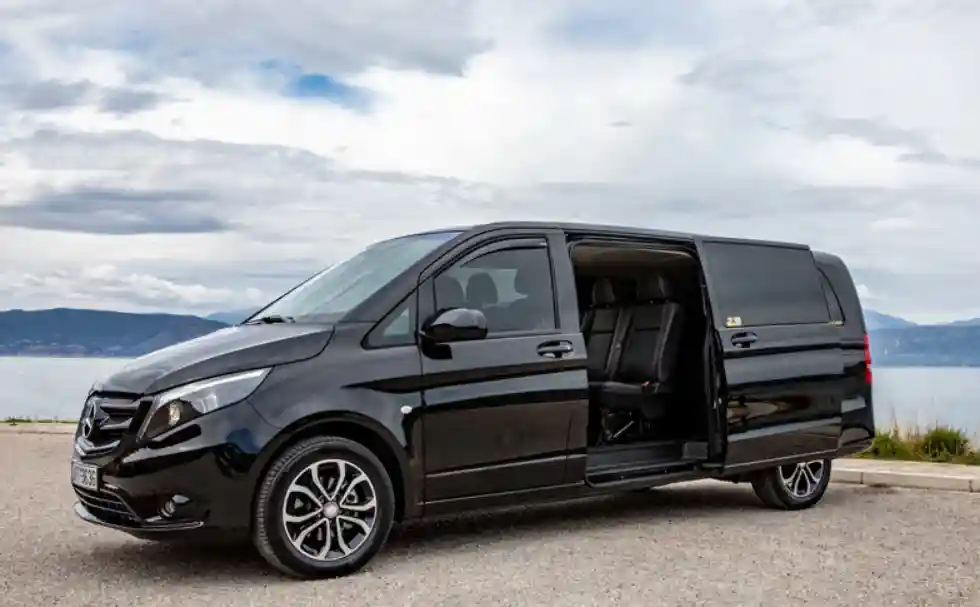
Luggage capacity that feels adequate for a short transfer may become restrictive during a journey lasting several hours. The booking should reflect the actual luggage volume before the vehicle category is assigned.
Request the required child equipment and include any pushchair within the overall luggage volume.
Several large suitcases may make a minivan appropriate even when the travelling party is relatively small.
Any special item should be communicated before confirmation so compatibility and available capacity can be checked.
The return journey requires careful timing. The vehicle has to leave Madrid, cover the A-2/AP-2 corridor, cross the Barcelona metropolitan area and reach T1 or T2 before check-in, security and boarding.
On a journey of more than 600 km, roadworks, traffic, accidents, adverse weather or congestion can affect any part of the route through the three autonomous communities involved.
The pickup location can add journey time before the vehicle even reaches the main A-2 corridor.
Barcelona-El Prat connects with a range of destinations that follow different roads and travel patterns. Each destination below represents a separate endpoint rather than a shorter version of the Madrid journey.
A major intermediate destination on the Barcelona–Madrid corridor, without continuing to the capital.
A destination within Catalonia, close to Lleida-Pirineus and the A-2 corridor.
Leave the main route after Lleida and continue north through Aragon via the A-22.
A much earlier endpoint within the same broad A-2 corridor, less than an hour from Barcelona.
Follow the Mediterranean corridor towards Valencia rather than taking the A-2 inland route to Madrid.
Travel south along the Mediterranean coast instead of crossing inland towards Madrid.
Leave the A-2 and head towards central Catalonia using a different road corridor.
Take the C-16 towards the Pre-Pyrenees rather than continuing for hundreds of kilometres towards Madrid.
Turn the inland journey into a Pyrenean route towards the Andorran border.
A long-distance Mediterranean destination following a completely different route and travel pattern.
The Barcelona–Madrid route is around 620 km. Depending on the airport starting point and the exact destination within Madrid, approximately 620–630 km is a reasonable planning range.
The usual road journey is around six hours. For practical planning, allow approximately 5 h 45–6 h 30 min depending on traffic, stops and the final address.
The usual corridor follows the AP-2/A-2 and passes through Zaragoza before continuing towards Madrid.
High-speed rail is much faster between the two cities on direct services. A private transfer provides a different journey format, with pickup at T1 or T2, one vehicle throughout, luggage remaining with the passengers and drop-off at a specific address.
A stop can be planned according to the booking conditions. Any stop that may affect the journey time or route should be communicated in advance.
Yes. Specify the exact station and, where relevant, the departure time of the onward train.
Yes. Madrid has a Low Emission Zone and other mobility regulations. The vehicle used for the required access must comply with the rules in force at the time of the service.
The appropriate category depends on passenger numbers and luggage. Families or smaller groups with several suitcases may require the additional capacity of a minivan, while larger groups can consider a minibus or coach.
Arriving on the A-2 does not necessarily mean that the transfer is complete. Chamartín, Salamanca, Sol, Atocha, Moncloa or a business address near the M-40 can all require very different final approaches. After travelling across much of the peninsula, the exact Madrid destination is just as important to the booking as the Barcelona Airport pickup point.
I had a 5:30 AM pickup for the airport in Alicante. The driver arrived 10 minutes early, sent a polite text to let me know he was waiting outside, and handled everything with absolute professionalism.(09/23/2026) David Miller
We used Zonetransfers for airport transfers back and forth during a family trip to Madrid. On-time pickups, comfortable vehicles, and very friendly drivers. Will definitely use them again.(09/15/2026) Evelyn Campbell
Booked a private transfer from Barcelona Airport to our city-center hotel. Our driver, David, was exceptionally polite, helped with our heavy luggage, and gave us a few great local tips on the way.(09/11/2026) Rachel Henderson
What I appreciate most is knowing the exact cost upfront without unexpected luggage surcharges or meter surprises. Quick booking on the website and excellent customer support throughout.(09/06/2026) Emma Reed
We needed a transfer from Barcelona to Girona Airport early in the morning. The driver was there on time and we got to the airport with plenty of time. Very handy.(09/01/2026) Rachel Moore
Booked a transfer from Lisbon Airport to Faro. Long drive, but the car was comfortable and the driver was friendly. We arrived without any problems.(08/30/2026) Tom Harris
We used Zonetransfers for a transfer from Madrid to Ciudad Real. The driver was on time and the car was comfortable. Exactly what we needed.(08/25/2026) Claire Morgan
Booked a private transfer from Lisbon Airport to Sintra. Driver was waiting when we came out and helped with the bags. Simple and hassle-free.(08/22/2026) Jack Wilson
We needed to get from Valencia to Barcelona with quite a few bags, so we decided to book a private transfer. The driver arrived on time, helped us with the luggage and we went straight to our hotel in Barcelona. It worked really well for us.(08/14/2026) Sophie Turner
We booked a transfer from Lisbon Airport to Faro as we were staying in the Algarve for a few days. It was a long drive but the car was comfortable and the driver was friendly. We just sat back and enjoyed the trip instead of worrying about trains and changing buses.(08/07/2026) James Walker